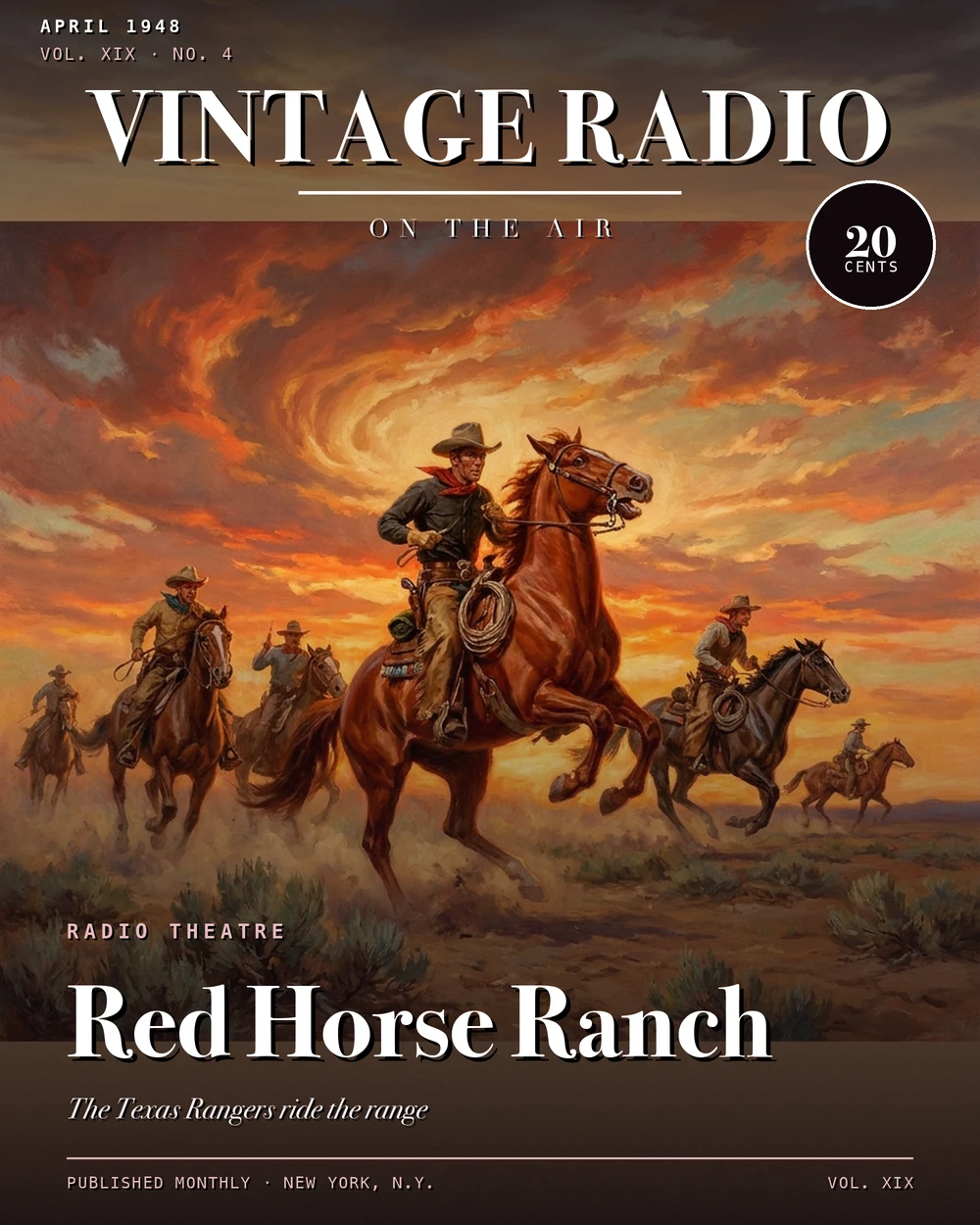
Red Horse Ranch
What It Was and Where It Came From
Red Horse Ranch — its full title was Life on Red Horse Ranch — was a serialized western drama that originated at KMBC in Kansas City in the spring of 1935. The first episode was produced in March of that year and delivered by April, with a confirmed air date of April 15, 1935 for Program #1. Arthur B. Church, who owned and operated KMBC, produced the show, which was recorded in Chicago and distributed through world syndication. Church's station was later described as "a model for the industry," and Red Horse Ranch was one of its more ambitious productions — a scripted, continuing serial with music woven in at every turn rather than a variety hour with a host and guests.
The show's promotional literature was explicit about what it was reaching for: Drama, Romance, Comedy, and Music were its four stated pillars. That wasn't a tagline so much as a production brief. Each episode advanced a continuous storyline, the music was performed by a resident ensemble rather than rotating guests, and the comedy came from characters with defined personalities rather than stand-up turns. In 1935, that combination — narrative serialization, integrated cowboy music, and character-driven humor — was still finding its shape on American radio, and Red Horse Ranch was one of the programs working out how to do it.
The Story at the Center
The dramatic spine of the show follows Sam Carter — known to everyone as Dad Carter — in his fight to hold onto Red Horse Ranch. The trouble is stacked against him from the start: a brutal winter that took half the herd, a banknote coming due, disputes over fencing, and land grabbers pressing from outside. Into this pressure arrives his daughter Rose, returning from school back East, which adds a domestic thread to the ranch's survival story.
Working the ranch alongside Dad are his hired hands, who also serve as the show's principal cast: Foreman Alabam', along with Tenderfoot, Idaho, Arizona, Cookie, and Tex. They work, they argue, they get into trouble, and they sing — all within the same episodes, sometimes within the same scenes. The comedy came specifically, as promotional literature put it, from "the colorful antics of Arizona and the lazy but lovable Cookie." Episode titles bear this out: one installment finds Cookie and Arizona reminiscing about the women they've known, another has Alabam' and Tenderfoot standing guard on the herd, and a third finds Mr. Carter — name slightly rearranged in the episode record as "Mr. Caters" — in desperate straits with half the herd gone. The serial kept its stakes grounded in ranch-life realities: debt, weather, livestock, and the people who depend on each other to get through it.
The Music and the Texas Rangers
The music on Red Horse Ranch was handled exclusively by the KMBC Texas Rangers, a resident ensemble built into the drama rather than appearing as a separate performance segment. KMBC's promotional materials credited the band with playing approximately twenty instruments. Their leader was Tex Owens, born June 15, 1892, who was already a well-known figure in Kansas City radio as co-host of KMBC's barn dance program Brush Creek Follies, where he performed with the Original Texas Rangers and his two daughters.
The songs the Rangers played on Red Horse Ranch were primarily old-time cowboy and range music, performed — as promotional copy described it — "in their natural setting" within the drama. That framing mattered: the music wasn't a break from the story, it was part of it. Cowboys sang while working, characters broke into song as part of their lives on the ranch, and titles like "Turkey in the Straw," "Good Old Mountain Music," "The Old Texas Trail," "Lay Still Little Doggies," "Down in Arkansas," and "When a Woman Gets the Blues" give a clear sense of the repertoire. The effect was closer to a musical drama than a music program with dramatic framing.
The year 1935, when the Texas Rangers were performing on Red Horse Ranch, also happened to be when Tex Owens composed and recorded "Cattle Call" for Decca Records — his biggest hit. The Rangers went on to appear in several B-Western films in the late 1930s and early 1940s, often alongside Johnny Mack Brown and Gene Autry, and became regulars on Autry's Melody Ranch on radio. Their time on Red Horse Ranch sits near the beginning of that run.
The Episodes That Survive
Twenty-six episodes are documented in the catalog here, and the episode numbers on record — including ep22 and ep26 — confirm that the total run extended beyond that count. The surviving episodes cover a range of the show's narrative and musical concerns: Alabam' recovering from an accident, the sheriff arriving to collect on the ranch debt, Cookie and Arizona's reminiscences, the crisis with the herd. Taken together, they give a fair picture of how the show balanced its four stated pillars across a continuing story.
A maintained collection for the show carries a "Certified Accurate" designation, Version 2, certified November 18, 2011 — meaning the episodes are properly identified and labeled, though the series may not contain every known extant installment. The Arthur B. Church KMBC Radio Collection, now held at the University of Missouri–Kansas City Marr Sound Archives, preserves recordings from the station's era and stands as a further record of what Church and KMBC produced during this period.
Why It's Worth Your Time
Red Horse Ranch occupies a specific and not-quite-replicated position in the western drama format. It wasn't a straight action serial — there were no gunfights driving the plots. It wasn't a pure music program. It was a show built around the working life of a ranch in trouble, with characters who sang because that's what ranch hands did, and whose comedy came from who they were rather than from jokes dropped into the script. That's a narrower target than it sounds, and the show hit it with enough consistency to attract an audience that, according to listener research of the period, overlapped significantly with fans of the Andrews Sisters Show and the Doris Day Show — audiences drawn to music with personality and warmth behind it.
The songs held to a cowboy and range tradition that was already starting to feel like a heritage repertoire by 1935. Performed by a band with real roots in Kansas City's barn dance circuit, and one that would go on to work with Gene Autry, the music wasn't decorative — it was the show's texture. Listeners tuning in each week got a continuing story about debt and weather and loyalty, delivered with fiddles, guitars, and the kind of songs that people already associated with the open range. That combination didn't outlast the decade in quite this form, which makes what Red Horse Ranch preserved in its surviving episodes worth hearing on its own terms.